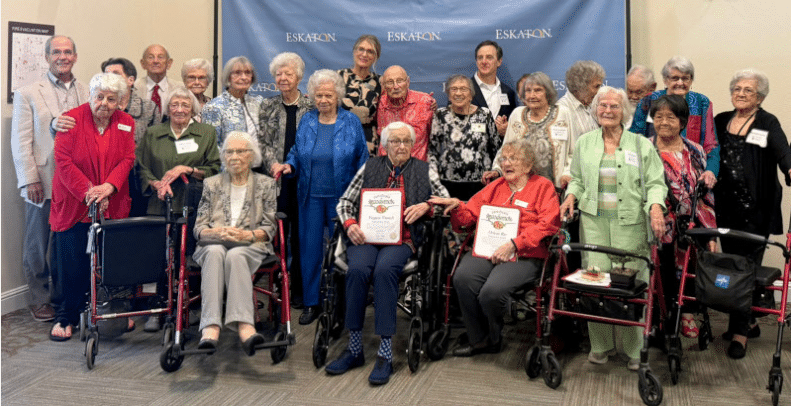
I overheard one centenarian say to the other: “I know why I’m here, do you know why you are?”
If I were a philosopher, I might have thought: “To be or not to be … that is the question.” But in that moment, surrounded by a room full of people who have lived a full century, the literal question she may have been asking her centenarian friend was: How did you make it to 100?
During an Eskaton centenarian celebration, I wandered the room speaking with the honorees, asking them about their secrets to longevity. This wasn’t my first time celebrating centenarians. Over the years, I’ve taken them on vintage airplane rides and joined in birthday parties filled with children, grandchildren, great-grandchildren — sometimes even great-great-grandchildren.
Each time I walk away struck by how these events push us to see aging differently. While some 100-year-olds need wheelchairs and walkers, others move like they’re in their 70s. Age and decline do not go hand-in-hand. But age and resilience do.
Talking to Eskaton residents, I heard, “I always eat my vegetables,” “I stay active,” “I read every day,” “I listen to music,” “I keep busy.” This reminded me of what we’ve learned through Dan Buettner’s book The Blue Zones and his Netflix series Live to 100: Secrets of the Blue Zones. Longevity science is real.